
What You’ll Discover
- Why wombats produce cube-shaped droppings - and the gut anatomy that makes it happen
- How a platypus hunts underwater with its eyes, ears, and nostrils all sealed shut, using electroreception
- Why koalas sleep up to 22 hours a day and how baby joeys develop the gut microbes to handle toxic eucalyptus leaves
- How millions of years of continental isolation drove Australian animals to evolve in ways found nowhere else on Earth
- The Guugu Yimithirr and Dharug origins of the everyday English words kangaroo, koala, and wombat
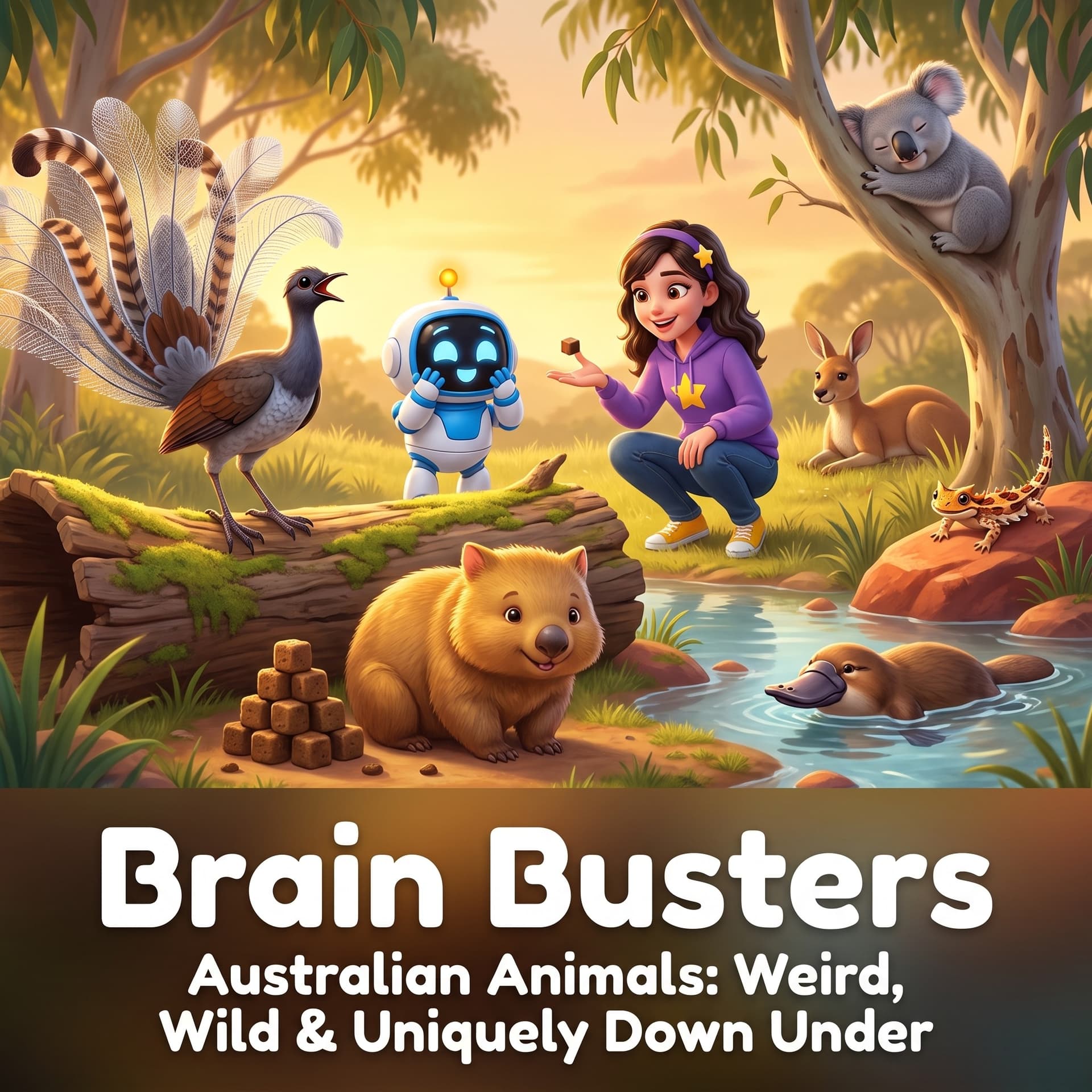
This episode of Brain Busters - the Brain Bus feed for ages 8 to 10 - takes kids deep into the science of why Australian animals look and behave so differently from anything else on Earth. In about 25 minutes, your child will find out why wombats produce cube-shaped droppings, how a platypus hunts with its eyes completely sealed, and what millions of years of isolation actually does to evolution. It is the kind of content that sparks real questions long after the car parks. Nova and Cosmo guide explorers through the biology behind Australia's most extraordinary animals - from koalas whose fingerprints can confuse forensic scientists, to thorny devil lizards that drink through grooves in their own skin. Kids discover that isolation is what drove these animals to solve life's problems in completely unexpected ways, making Australia the greatest natural experiment in evolutionary history. This episode works as a kids science podcast for ages 8–10 and as a family trivia podcast for road trips, with three quiz questions, a whole-car imagination challenge, and a Dreaming story about the giant frog Tiddalik told by the Gunaikurnai people of Gippsland. Educational podcast for kids moments are woven throughout naturally, including the Guugu Yimithirr and Dharug language origins of words like 'kangaroo,' 'koala,' and 'wombat.'
Chapters
Tap any chapter to jump straight to that part of the episode.