What You’ll Discover
- A barn owl's ears are set at different heights on its skull, letting its brain pinpoint a mouse's exact location from sound alone - no light needed.
- Every bat can see; echolocation is a second sense stacked on top of working eyes, not a replacement for them.
- Scorpions glow blue-green under ultraviolet light - something in their hard outer shell absorbs UV and releases it as visible light - and scientists are still working out exactly why.
- The tarsier's eyes are each as large as its brain, but they are fixed solid in the skull, so the animal swivels its whole head to look sideways.
- Some animals are crepuscular rather than nocturnal - rabbits, for example, are most active at dawn and dusk, in the low-light window between day and night shifts.
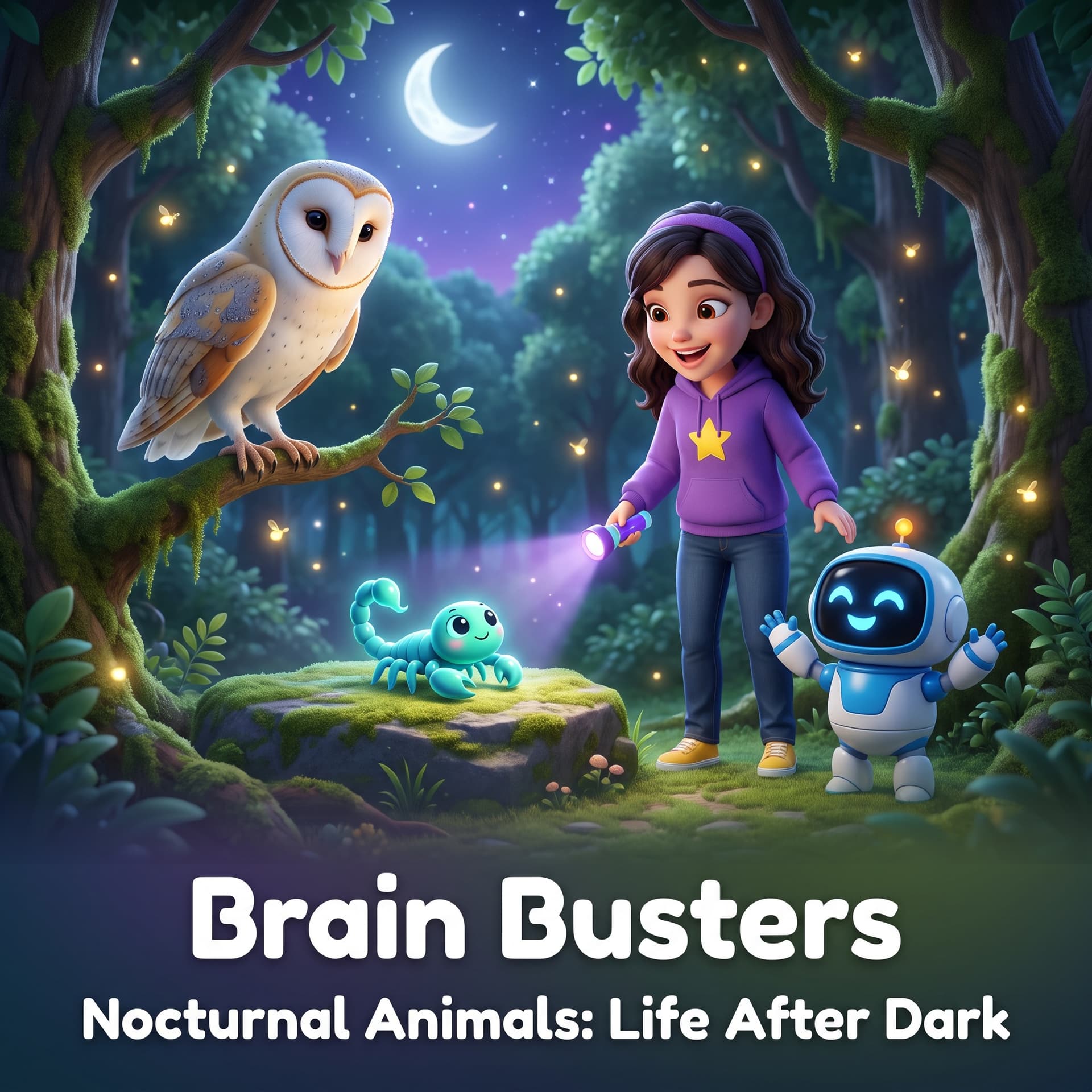
In this episode of The Brain Bus: Brain Busters, your 8-to-10-year-old discovers that a barn owl can locate a mouse in total darkness using sound alone - because one ear sits higher on its skull than the other. It is about 17 minutes of genuinely surprising animal science, delivered at exactly the right level for this age group. Nova and Cosmo guide explorers through the hidden world of nocturnal animals, sense by sense - from the tarsier's eyeballs (each one as large as its brain) to scorpions that glow blue-green under ultraviolet light. Kids find out why bats are not blind, how geckos see colour in near-total darkness, and what the ancient Greeks stamped onto their silver coins. This episode works well as a kids science podcast for ages 8-10, doubles as a family trivia podcast on road trips, and naturally builds scientific vocabulary including words like "tapetum lucidum" and "crepuscular." A Road Challenge asks everyone in the car to close their eyes and map sounds by direction - exactly what a hunting barn owl does.
Chapters
Tap any chapter to jump straight to that part of the episode.