
What You’ll Discover
- T. rex lived closer in time to us than to Stegosaurus. Stegosaurus was already gone for over 80 million years before T. rex was born
- The famous T. rex roar was invented by movie sound designers, real T. rex likely made deep closed-mouth rumbles you would feel in your chest before you heard them
- T. rex probably could not run — its legs were so heavy that sprinting may have snapped its own bones, so it hunted by getting close quietly and using its devastating bite
- Birds are not just relatives of dinosaurs they are dinosaurs, making the chicken in your kitchen a living descendant of the T. rex family line
- Scientists are still actively debating what T. rex's small arms were actually for, and whether parts of its body were covered in feathers
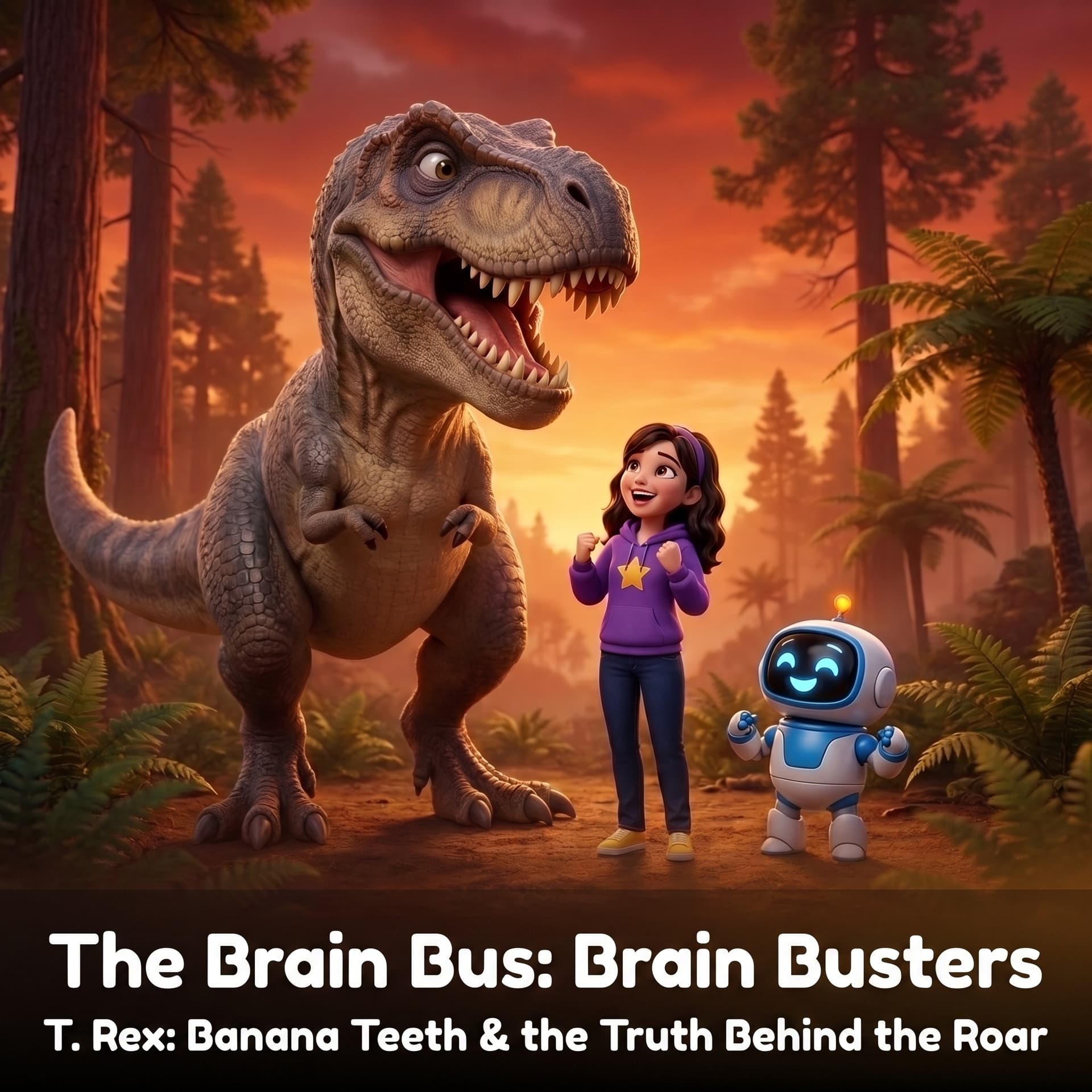
This episode of The Brain Bus: Brain Busters gives kids aged 8-10 a genuinely surprising picture of T. rex, one built on current science rather than movie mythology. In around 25 minutes, your child will find out that the famous roar was invented in a sound studio, that T. rex probably couldn't run at all, and that its closest living relative is a chicken. Warm, funny, and grounded in real palaeontology. Nova and Cosmo take explorers deep into the Cretaceous to rebuild T. rex from the ground up, banana-shaped teeth designed for crushing bone, forward-facing eyes built for precision, and those famously small arms that scientists are still debating today. Along the way, kids discover why T. rex didn't need speed, what a 44-centimetre piece of fossilised poop tells us about the strongest bite ever recorded on land, and why the next T. rex discovery might be made by a child sitting in a car right now. This kids science podcast for ages 8-10 works equally well as a family trivia podcast for a road trip or a conversation-starter for the drive home. As an educational podcast for kids, it treats unanswered questions as features, not gaps, modelling the same curiosity that real palaeontologists use every day.
Chapters
Tap any chapter to jump straight to that part of the episode.